
How many seconds of totality you will see, from where you'll be standing.
On 12 August 2026 a total solar eclipse crossed the Iberian Peninsula: the first with totality visible from here since 1905. With the Sun only a few degrees above the horizon, the practical question wasn't where the shadow fell, but what the mountain in front of you was hiding.
Eclipsi.info works out the real seconds of totality from each person's exact spot, mountains included. A table by city doesn't cut it: it runs a topocentric calculation for the user's coordinates and altitude, with lunar parallax and refraction, and traces the real 360° horizon from the digital terrain model. With the Sun that low, one ridge to the west could hide totality entirely.
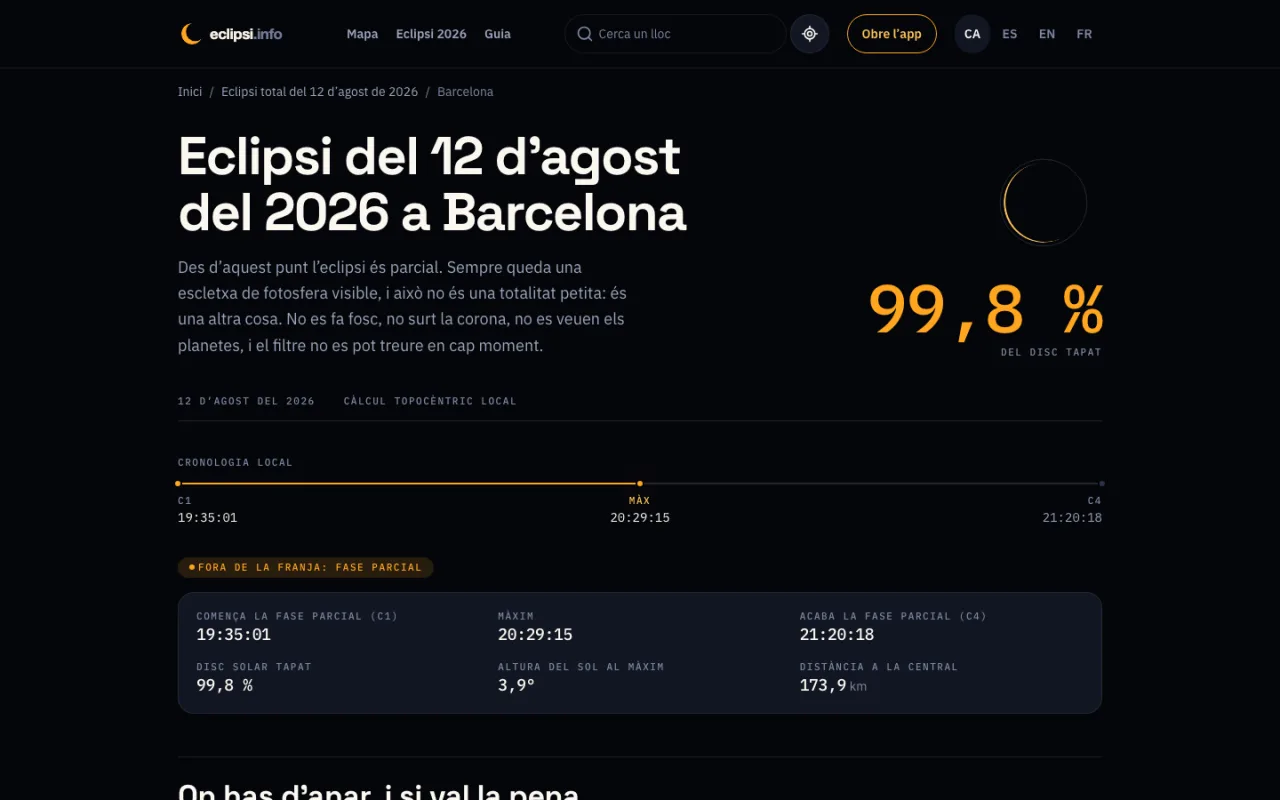
Three product decisions explain much of the coverage it got.
They published their official viewing points inside the tool. That, plus named sources, is why mainstream outlets could recommend it without reservations.
The domain had no traffic before 2 August: 88 visitors. On the 4th that multiplied by 55 with the first wave of press. Everything on this page happened in ten days.
The peak was 570,865 requests in one hour, about 158 a second. The next hour dropped to 171,640 and the one after to 29,424: a 95% collapse in two hours. People checked the site until the last moment, then left the screen to watch the sky.
That's the best summary of what it was for: a tool used heavily, very fast, that stops being needed at the exact instant the thing that matters begins.